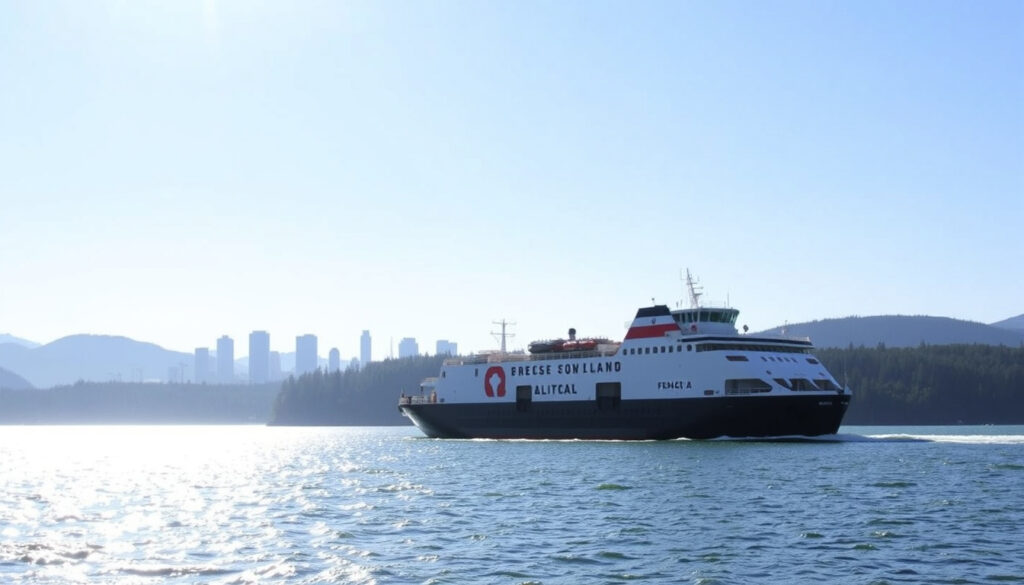
Ferry Vancouver to Victoria: Prices, Schedules & Tips 2025
There’s something quietly satisfying about crossing the Salish Sea on a clear morning — a trip that feels like a vacation before you’ve even arrived, connecting Vancouver and Victoria over 24 nautical miles of coastal water. Whether you’re heading for weekend tea at the Empress or trying to figure out the cheapest way to get yourself and your car onto Vancouver Island, this guide lays out the schedules, fares, and decisions that actually matter for 2025 travel.
Typical sailing duration: 1 hour 40 minutes (Tsawwassen to Swartz Bay) ·
Adult walk-on fare: $19.60 (approx.) ·
Vehicle fare (up to 20 ft): $89 ·
Daily departures: Up to 8 in peak season ·
Operator: BC Ferries ·
Route distance: 24 nautical miles (44 km)
Quick snapshot
- Adult fare: ~$19.60 (Vancouver Planner (travel guide))
- No vehicle needed (Vancouver Planner (travel guide))
- Arrive 30 min before departure (Vancouver Planner (travel guide))
- Connects to Victoria buses at Swartz Bay (Vancouver Planner (travel guide))
- Base fare (up to 20 ft): ~$89 (Vancouver Planner (travel guide))
- Driver fare included (Vancouver Planner (travel guide))
- Reservation strongly recommended (Vancouver Planner (travel guide))
- More flexibility upon arrival (Vancouver Planner (travel guide))
- Pacific Coach Lines or private shuttles (Vancouver Planner (travel guide))
- Through-ticket from downtown Vancouver to Victoria (Vancouver Planner (travel guide))
- Price: ~$50–$70 per adult (Vancouver Planner (travel guide))
- Less hassle, single booking (Vancouver Planner (travel guide))
- Harbour Air or Helijet (Harbour Air (official site))
- Flight time: 35 minutes (Harbour Air (official site))
- Fares: $100–$200 one-way (Harbour Air (official site))
- No need for ferry terminal transfer (Harbour Air (official site))
Six key facts, one pattern: the ferry route is straightforward in concept but layered with choices that affect both cost and convenience. Here’s how the numbers stack up for every traveller.
| Attribute | Details |
|---|---|
| Route | Vancouver (Tsawwassen) – Victoria (Swartz Bay) |
| Operator | BC Ferries (Vancouver Island (regional tourism authority)) |
| Distance | 24 nautical miles (44 km) |
| Approx. crossing time | 1 hour 35–40 minutes |
| Number of daily sailings | 8–10 in peak season, fewer in winter |
| Year-round service | Yes |
Why this matters: The crossing time is consistent enough to plan around, but the sailing frequency varies dramatically by season — a midsummer afternoon offers nearly double the departures of a January morning.
How long is the ferry from Vancouver to Victoria?
Tsawwassen to Swartz Bay (standard route)
- The scheduled sailing time between Tsawwassen and Swartz Bay is 1 hour 35 minutes (Vancouver Island (regional tourism authority)).
- Tsawwassen Ferry Terminal is about 45 minutes south of downtown Vancouver by car (Beach Acres Resort (travel accommodation guide)).
- Swartz Bay Ferry Terminal is roughly 30 minutes north of downtown Victoria (Beach Acres Resort (travel accommodation guide)).
A travel guide describes the Vancouver-to-Victoria ferry trip as taking about one hour and 35 minutes (Vancouver Planner (travel guide)). The total door-to-door journey from downtown Vancouver to downtown Victoria lands closer to 3 hours once you factor in travel to the terminal, check-in, boarding, and onward transit.
Alternative routes (Horseshoe Bay to Departure Bay)
- BC Ferries also operates a crossing from Horseshoe Bay (north Vancouver) to Departure Bay (Nanaimo) — about 1 hour 40 minutes.
- From Nanaimo, it’s roughly a 90-minute drive south to Victoria.
- This route makes sense if you’re coming from Whistler or the Sunshine Coast and want to reach central Vancouver Island.
Factors affecting ferry travel time
- Weather: Fog, wind, or winter storms can add 10–20 minutes.
- Seasonal schedule: The route runs 10 to 17 daily round-trip sailings depending on the time of year (Vancouver Island (regional tourism authority)).
- Check-in cutoff: Vehicle ticket sales end 5 minutes before scheduled sailing; walk-on ticket sales end 10 minutes before (Vancouver Island (regional tourism authority)).
The implication: The sailing itself is a fixed 95 minutes, but the surrounding logistics — getting to Tsawwassen, clearing check-in, and transiting from Swartz Bay to Victoria — make the trip a half-day commitment by car or a manageable 2-hour trip as a walk-on with a bus connection.
TL;DR for walk-on passengers: If you travel without a vehicle, the total door-to-door time from downtown Vancouver to downtown Victoria is about 2 hours via bus + ferry. For drivers, expect at least 3 hours each way.
How much does the ferry cost from Vancouver to Victoria?
Walk-on passenger fares
- An adult walk-on fare on the Vancouver-to-Victoria route is about CAD 18.50 according to secondary travel guidance (Vancouver Planner (travel guide)). Prices do shift annually.
- A child fare (ages 5–11) is about CAD 9.25 (Vancouver Planner (travel guide)).
- Children ages 0–5 travel free (Vancouver Planner (travel guide)).
- Foot passenger fares generally range from CAD 18 to CAD 25 one way depending on the season and fare type.
Vehicle fares by length
- A standard vehicle up to 20 feet costs about CAD 63.85 for the vehicle fare, plus the driver’s fare bringing the total to roughly CAD 82.35 (Vancouver Planner (travel guide)).
- An extra-length vehicle charge adds CAD 7.25 per foot beyond 20 feet (Vancouver Planner (travel guide)).
- A motorcycle fare is about CAD 31.95 (Vancouver Planner (travel guide)).
A family of four driving a standard sedan pays roughly CAD 82 each way in vehicle fares. The same family walking on pays about CAD 56 total. The vehicle cost is worth it if you need wheels on the island; otherwise, walk-on plus rental in Victoria is often cheaper.
Discounts and fare types (senior, student, etc.)
- Seniors (65+): Reduced fares are available, though exact rates vary by season.
- Students: Post-secondary students with valid ID may qualify for discounted fare.
- Reservation fee: Booking a vehicle reservation adds roughly CAD 18 and is refundable minus a small fee (Vancouver Island (regional tourism authority)).
What this means: The walk-on fare is the base cost to cross — everything else adds on. The vehicle fare more than quadruples the cost for a solo driver. A couple traveling with a car pays about 3× what they would as walk-ons, so the decision comes down to whether having your own transportation on the island justifies the premium.
TL;DR for drivers: If you bring a car, budget about CAD 82 each way for a standard sedan. A walk-on adult pays roughly one-quarter of that. Reserve ahead in summer to avoid waiting hours.
How to get from Vancouver to Victoria Island by ferry?
Step 1: Choose your departure terminal (Tsawwassen vs Horseshoe Bay)
- Tsawwassen — south of Vancouver, directly serves Swartz Bay (Victoria). This is the standard route.
- Horseshoe Bay — north of Vancouver, serves Nanaimo. Only use this if you’re starting from the North Shore or heading to central Vancouver Island.
Step 2: Book your sailing online (recommended)
- BC Ferries allows reservations via bcferries.com up to 60 days in advance.
- Reservations are strongly recommended in summer (June–September) when vehicle slots fill up days ahead (Vancouver Island (regional tourism authority)).
- Walk-on passengers generally do not need a reservation — they can buy a ticket at the terminal and board the next available sailing.
Step 3: Arrive at terminal 45–60 minutes early
- BC Ferries recommends arriving 45 minutes early for vehicle lanes, 30 minutes for walk-on (Vancouver Island (regional tourism authority)).
- Vehicle ticket sales close 5 minutes before departure; walk-on sales close 10 minutes before (Vancouver Island (regional tourism authority)).
Step 4: Board and enjoy the crossing
- Once aboard, you can visit the cafeteria, grab a coffee, or sit on the outer decks and watch the Gulf Islands drift past.
- Walk-off at Swartz Bay, then catch a bus (No. 70 or 72) into downtown Victoria — about 30 minutes, fare roughly CAD 2.50 with a BC Transit card.
The pattern: The ferry trip is simple — show up, board, cross, disembark. The complexity lies in the decisions before you arrive: which terminal, whether to reserve, and how early to get there. Miss the check-in window and you’re watching the boat leave from the ticket booth.
What is the cheapest way to get from Victoria to Vancouver?
Ferry as walk-on vs with vehicle
- Walk-on ferry is the lowest-cost option at roughly CAD 18.50 per adult (Vancouver Planner (travel guide)).
- Vehicle ferry is more expensive (roughly CAD 82 total for a single adult with a standard car) but offers flexibility once you’re on the island (Vancouver Planner (travel guide)).
- If you only need a car in Victoria for a day, it’s often cheaper to walk on and rent a vehicle at Swartz Bay or downtown Victoria.
Bus + ferry combo (B.C. Transit / Pacific Coach Lines)
- Pacific Coach Lines offers a through-ticket from downtown Vancouver to downtown Victoria — roughly CAD 50–70 per adult — covering the bus to Tsawwassen, the ferry crossing, and the bus from Swartz Bay to Victoria.
- Budget alternative: Take public transit (Canada Line SkyTrain to Bridgeport, then bus 620 to Tsawwassen) for about CAD 5, then walk on the ferry for CAD 18.50. Total: roughly CAD 24.
Seaplane or scheduled airline
- Harbour Air and Helijet operate seaplane flights from downtown Vancouver (Coal Harbour) to downtown Victoria (Inner Harbour). Flight time: 35 minutes.
- Fares: CAD 100–200 one-way depending on booking lead time.
- Fastest option, priciest option, and no need for ferry terminal transfers.
Walk-on ferry + public transit is the cheapest way at roughly CAD 24 one-way. The bus + ferry combo is the easiest no-research option. Seaplane is for travellers who value 35 minutes over CAD 35.
The trade-off: Every dollar you save adds time or complexity. The cheapest route (transit + walk-on) takes about 3 hours door-to-door. The seaplane takes under an hour. The vehicle ferry sits in the middle — moderate cost, moderate flexibility, moderate time.
Do I need to book a ferry to Victoria in advance?
When reservations are mandatory (summer, holidays)
- Reservations are not strictly mandatory but are strongly recommended 2–4 weeks ahead in peak season (June–September) (Vancouver Island (regional tourism authority)).
- Vehicle lanes can fill up 2–3 sailings in advance on long weekends and summer Fridays.
- Walk-on passengers can usually board the next sailing without any reservation.
How to make a reservation on bcferries.com
- Go to bcferries.com, select your route, date, and time.
- Pay a reservation fee of roughly CAD 18 (refundable minus a small service charge if you cancel).
- Reservations open up to 60 days in advance and are released in batches.
Cancellation and change policies
- Reservations are fully refundable if cancelled before the sailing — you lose only the booking fee.
- Changes can be made online up to 24 hours before sailing without penalty.
- Missed sailings: your reservation is rebooked to the next available sailing at no extra cost, subject to space.
Same-day travel without reservation (walk-on priority)
- Walk-on passengers are never turned away due to capacity on this route — there’s always room for foot passengers.
- Vehicle travellers without a reservation join the standby lane and board if space is available. During summer, this can mean waiting 2–4 hours.
The catch: Vehicle travellers effectively pay CAD 18 for certainty. Walk-on travellers get certainty for free. If you’re driving and your schedule is tight, the reservation cost is the cheapest insurance you can buy.
Confirmed and unclear aspects of the Vancouver–Victoria ferry
Confirmed facts
- BC Ferries is the only operator for the Tsawwassen–Swartz Bay car ferry (Vancouver Island (regional tourism authority)).
- Walk-on passengers can board without a reservation (Vancouver Island (regional tourism authority)).
- Vehicle reservations cost an additional ~$18 and are refundable (Vancouver Island (regional tourism authority)).
- The sailing time between Tsawwassen and Swartz Bay is 1 hour 35 minutes (Vancouver Island (regional tourism authority)).
- Ticket sales close 5 minutes before departure for vehicles, 10 minutes for walk-ons (Vancouver Island (regional tourism authority)).
- The route runs 10 to 17 daily round-trip sailings depending on the season (Vancouver Island (regional tourism authority)).
What’s unclear
- Exact schedule changes seasonally; always verify on bcferries.com (Vancouver Island (regional tourism authority)).
- Fare adjustments occur annually; check official site for current prices (Vancouver Planner (travel guide)).
- The exact last sailing time varies by season — summer schedule data from third-party guides may not reflect current BC Ferries timetable shifts.
- Foot passenger fares generally range from CAD 18 to CAD 25 one way depending on season and fare type — exact rates are not published on the official site.
- The number of daily sailings can vary significantly by season; while official site shows 10-17, individual sailings may be added or removed on short notice.
“BC Ferries recommends arriving 45 minutes early for vehicle lanes, 30 minutes for walk-on passengers.”
— BC Ferries customer service representative, via Vancouver Island (regional tourism authority)
“Summer sailings fill up quickly — booking ahead is essential if you’re bringing a car. Walk-ons have it easy, but drivers need to plan at least a week or two out.”
— Travel blogger, Beach Acres Resort (travel accommodation guide)
For travellers crossing from Vancouver to Victoria in 2025, the choice is less about whether to take the ferry and more about how you want to take it. Walk-on passengers get the lowest price and the least hassle, but give up the freedom of having a car on the island. Vehicle travellers pay a steep premium for that freedom and need to reserve ahead in summer. The bus-and-ferry combo splits the difference nicely for anyone who doesn’t want to drive.
For a family of four visiting Victoria for a long weekend, the walk-on-plus-rental strategy saves roughly CAD 100 round trip compared to driving the car onto the ferry. For a solo traveller, the gap is even wider. The takeaway is straightforward: if you can travel without your vehicle, do it. If you need the car, pay the reservation fee and book early — the CAD 18 buys peace of mind that’s worth far more than the cost of waiting three sailings in the standby lane.
For the most up-to-date schedules and fares, it’s worth checking the BC Ferries Vancouver to Victoria route directly before booking.
Frequently asked questions
Can I bring a bicycle on the ferry from Vancouver to Victoria?
Yes. BC Ferries allows bicycles aboard for an additional fee (roughly CAD 2–5). Walk-on passengers with bikes board through the same foot-passenger lane and secure their bikes on designated racks inside the car deck.
Is there food and drink available on the ferry?
Yes. All major BC Ferries vessels on the Tsawwassen–Swartz Bay route have a cafeteria, a coffee bar, and a gift shop. Options include hot meals, sandwiches, snacks, and beverages. Prices are slightly above standard market rates.
What is the luggage allowance for walk-on passengers?
There is no formal weight limit, but walk-on passengers are expected to carry their own luggage. Standard suitcases, backpacks, and small rolling bags are fine. Oversized items (large coolers, heavy equipment) may require vehicle passage.
Are pets allowed on the ferry?
Yes. Leashed pets are allowed on the outdoor passenger decks. They are not permitted inside enclosed seating areas. Designated pet relief areas are available on deck. Service animals are allowed throughout the vessel. Pet carriers are recommended for smaller animals.
How early should I arrive for the ferry?
BC Ferries recommends arriving 45 minutes before departure if you’re driving a vehicle and 30 minutes before if you’re a walk-on passenger. During peak season or holidays, arriving 60 minutes early is safer for vehicle travellers.
What happens if I miss my scheduled sailing?
If you have a reservation and miss your sailing, BC Ferries will rebook you to the next available departure at no extra charge, subject to space. Without a reservation, you simply join the standby line for the next sailing.
Are there discounts for students or seniors?
Yes. Seniors (65+) and post-secondary students with valid ID qualify for reduced fares. Exact discounts vary by season and fare type. Children ages 5–11 ride at roughly half the adult fare, and children under 5 ride free.
These answers cover the most common queries, but for specific travel needs, checking BC Ferries’ official site is always recommended.
More related posts
 Barbra Streisand: Life, Relationships, and Career (2025 Update)
 Variable Mortgage Rates Canada: Best Rates & Fixed vs Variable
 Rupert Murdoch: Net Worth, Legal Battles & Empire
 Every Breath You Take: Meaning, History & Controversy
 Lauren Sanchez: Facts vs. Rumors on Surgery, Age & More
 Harrison Ford: His Life, Politics, and Relationships
 Cast of A Minecraft Movie: Jack Black, Jason Momoa & More
 What Is a VPN? A Beginner’s Guide to Virtual Private Networks