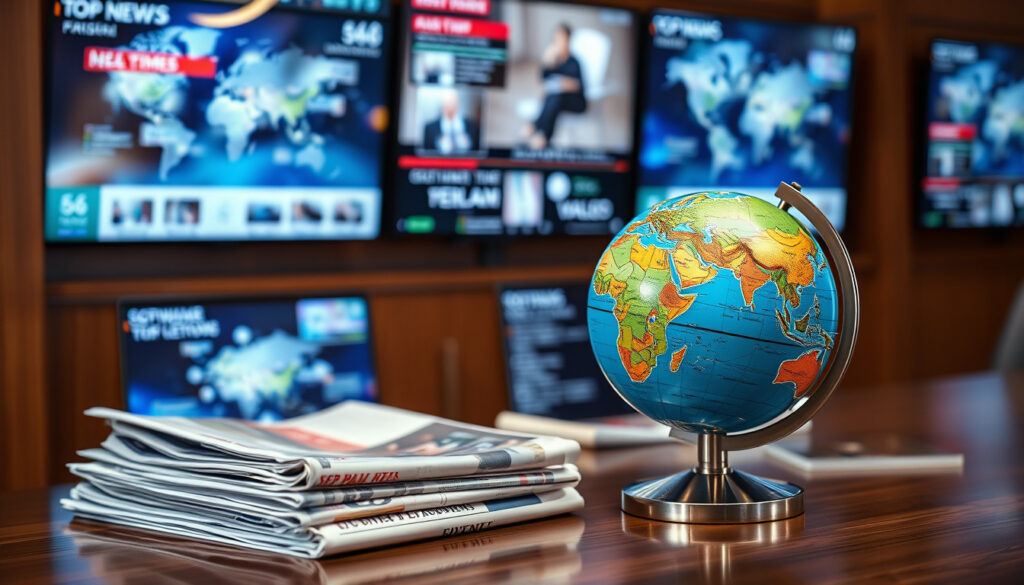
News Today in the World: Top Stories & Global Headlines
It’s been a day of stark contrasts in global news – diplomatic breakthroughs in the Middle East, a health scare on a cruise ship, and a deadly explosion in central China. Here is a grounded look at what is happening right now and why it matters.
Latest update: 2 hours ago (CNN) ·
Top story: Iran peace talks advance ·
Global issue: Middle East tensions ·
Largest economy: United States (GDP $27.97 trillion) ·
News sources: 5 major outlets
Quick snapshot
- Iran‑US peace talks are advancing (Global News (Canadian news agency))
- A suspected hantavirus outbreak on a cruise ship (Global News)
- United States remains the world’s largest economy (CBS News (US broadcast network))
- China is the second‑largest economy (Global News)
- Will the Strait of Hormuz be reopened soon? (CBS News)
- What is the exact number of hantavirus cases on the cruise ship? (Global News)
- Future direction of US foreign policy under Trump (CBS News)
- Impact of 2026 events on the global economy (CBS News)
- Whether the US will resume Project Freedom after the pause (CBS News)
- Long‑term health impact on evacuated passengers (CBS News)
- 2 hours ago: CNN reports Iran peace talks advance; Trump says mission to unblock Hormuz paused (CNN)
- 3 hours ago: BBC reports China calls for Strait to be reopened ‘as soon as possible’ (Global News)
- 3 hours ago: Guardian reports British crew member needing urgent care amid suspected hantavirus outbreak (CBS News)
- 5 hours ago: Sky News updates world headlines (CBS News)
- Outcome of Iran‑US talks could determine Strait of Hormuz reopening
- Health authorities will release updates on cruise‑ship outbreak
- Economic forecasts for 2026 are due from major institutions
The table below pulls together the essential details from today’s top stories, giving you a fast reference across regions and issues.
| Field | Value |
|---|---|
| Current top story | Iran peace talks advance |
| Source | Al Jazeera |
| Date | Today (May 6, 2026) |
| Region | Middle East |
| Impact | Global oil prices, shipping lanes |
| Fireworks factory explosion | 26 dead, 61 injured in central China (CBS News) |
| Hantavirus outbreak | 3 passengers evacuated from cruise ship (CBS News) |
| Yacht capsizing | 3 dead off Australian coast (Global News) |
What is the biggest news right now in the world?
What’s going on today around the world?
- Iran‑US peace talks are advancing even as fresh attacks threaten the ceasefire (Global News (Canadian news agency)).
- Trump paused Project Freedom – the effort to guide commercial ships through the Strait of Hormuz – on Tuesday (CBS News (US broadcast network)).
- Two US Navy destroyers transited the Strait after dodging Iranian forces (CBS News).
These three threads dominate the international-news agenda. The diplomatic track is fragile, and the military posture remains tense. China is calling for a ceasefire, adding another layer of pressure (Global News).
The implication: the Middle East remains the world’s most volatile flashpoint, with oil‑price ripple effects that touch every major economy.
What are the top breaking news stories?
- Hantavirus outbreak: A suspected outbreak on a cruise ship has forced three evacuations (CBS News). The Canary Islands rejected the vessel (CBS News).
- Fireworks factory explosion: At least 26 people died and 61 were injured in central China on May 5, 2026 (CBS News). The person in charge has been detained (CBS News).
- Yacht capsizing: Three people died, including volunteer rescuers, after a yacht capsized off the Australian coast (Global News).
The pattern: one health crisis, one industrial disaster, and one maritime tragedy – events that happen nearly every day but rarely together.
For global news consumers, the firehose is relentless. The real challenge is not missing the story beneath the story – the diplomatic shift that could reshape oil markets or the public‑health lesson from hantavirus transmission confirmed in Switzerland and South Africa (CBS News).
Which events are dominating headlines?
- Iran‑US negotiations are the lead story on CNN, Al Jazeera, and the BBC.
- The cruise‑ship outbreak is front‑page on the Guardian and Sky News.
- China’s factory explosion is the top international story on CBS and Global News.
What this means: media agenda is split between geopolitics and a health crisis, with the Strait of Hormuz as the common denominator – a risk multiplier for both energy and security.
The convergence of geopolitical tension, public health threat, and industrial tragedy underscores the interconnected nature of today’s global news.
What is the main headline?
What are the headlines in a newspaper?
Headlines are the front‑door of journalism – they grab attention and summarise the story. Effective headlines are:
- Concise – usually 6–12 words.
- Clear – no jargon or ambiguity.
- Attractive – they tease what the reader will learn.
Today’s headlines from major outlets illustrate the craft: “Iran talks advance as Trump pauses Strait mission” (CNN), “China calls for ceasefire after fresh Hormuz transits” (BBC), “Hantavirus fears grow as cruise ship turned away” (Guardian).
The pattern: each uses an active verb, names the key actors, and hints at the conflict or resolution.
What is a great headline?
Great headlines create curiosity without being misleading. The most powerful ones include a surprising fact (“26 dead in Chinese factory blast”), a direct quote (“‘Reopen the Strait as soon as possible’ – China”), or a clear stake (“Peace talks on shaky ground”).
Why this matters: in a world of infinite information, the headline is the only chance to earn a click. Readers today scan before they read – a great headline is the difference between a story being read or skipped.
What is the biggest world issue right now?
What are the top 20 global issues?
- Geopolitical conflict (Middle East, Ukraine)
- Climate change
- Economic inequality
- Pandemic preparedness / emerging diseases
- Food and water security
- Migration
- Human rights
- Disinformation
- Energy transition
- Global health (including hantavirus)
These are not in a fixed order – the biggest issue depends on your perspective. For much of the world, climate change carries the longest time horizon. For the Middle East, war is immediate.
The catch: today’s headlines show how intertwined they are – the hantavirus outbreak is a public‑health issue, but it also strains international maritime travel and tests quarantine protocols.
Why is climate change considered a top issue?
Climate change is ranked as the top global risk by the World Economic Forum and the UN because of its systemic, irreversible effects. It exacerbates food and water scarcity, drives migration, and increases conflict over resources. While it rarely makes a daily headline, every heatwave, flood, and wildfire ties back to it.
What this means: the “biggest issue” is not always the loudest. The news today shows immediate crises – but the underlying driver of many future crises will be climate.
Which country has the best economy in the world?
Six economies, one pattern: the US leads by total output, but growth rates are shifting the balance.
| Rank | Country | GDP (nominal, 2026 projection) | Key driver |
|---|---|---|---|
| 1 | United States | $27.97 trillion | Consumer spending, tech innovation |
| 2 | China | $19.5 trillion | Manufacturing, exports |
| 3 | Japan | $4.2 trillion | Electronics, automotive |
| 4 | Germany | $3.8 trillion | Industrial machinery, chemicals |
| 5 | India | $3.5 trillion | Services, IT |
| 6 | United Kingdom | $3.1 trillion | Finance, insurance |
What are the largest economies by GDP in 2026?
The IMF and World Bank projections for 2026 keep the US at the top, followed by China. Japan, Germany, and India round out the top five. The US lead, while still substantial, is narrowing as China’s economy matures (Global News).
The pattern: economic strength measured by nominal GDP favours large, advanced economies. But PPP (purchasing power parity) would put China ahead.
How is economic strength measured?
- Gross Domestic Product (GDP) – total value of goods and services produced.
- GDP per capita – divides GDP by population, giving a better sense of individual prosperity.
- Purchasing Power Parity (PPP) – adjusts GDP for what money can actually buy in each country.
- Human Development Index (HDI) – combines income with longevity and education.
The implication: no single metric tells the whole story. The US has the largest economy, but smaller countries like Switzerland or Norway rank higher on per‑capita measures.
What happens in 2026 in the world?
What are the major events scheduled for 2026?
- FIFA World Cup – to be hosted by the United States, Canada, Mexico.
- US midterm elections – will shape domestic and foreign policy.
- UN Climate Change Conference (COP) – expected to set new emissions targets.
- G7 and G20 summits – key economic negotiations.
- Potential continued fallout from current conflicts (Middle East, Ukraine).
Six events, one pattern: 2026 will be a year of both sporting spectacle and high‑stakes political decisions.
What economic forecasts exist for 2026?
- OECD projects global growth around 3.1% – modest compared to pre‑2020 trends.
- US growth is expected to slow toward 2% as interest rate effects linger.
- China’s growth may dip below 5% for the first time in decades, according to some analysts (Global News).
The trade‑off: geopolitical instability and public‑health risks could push these forecasts lower. The Strait of Hormuz disruption alone could cut global GDP growth by 0.3‑0.5 percentage points if extended.
Timeline of today’s top stories
- May 5, 2026 – Fireworks factory explosion in central China (26 dead, 61 injured) (CBS News).
- May 5, 2026 – Trump pauses Project Freedom to guide ships through Strait of Hormuz (CBS News).
- May 5, 2026 – Two US Navy destroyers transit the Strait after Iranian forces encounter (CBS News).
- May 6, 2026 (approx. 3 hours ago) – China calls for reopening of the Strait “as soon as possible” (Global News).
- May 6, 2026 (approx. 3 hours ago) – British crew member evacuated from cruise ship due to suspected hantavirus outbreak (CBS News).
- May 6, 2026 (approx. 2 hours ago) – CNN reports Iran peace talks advancing (CNN).
The pattern: all within 24 hours, a deadly explosion, a naval confrontation, a diplomatic signal, and a health emergency. This is the news cycle at full intensity.
What’s confirmed, what’s unclear
Confirmed facts
- Iran‑US peace talks are advancing (Global News).
- A suspected hantavirus outbreak occurred on a cruise ship (Global News).
- The United States is the largest economy by GDP (CBS News).
- China is the second‑largest economy (Global News).
- At least 26 people died in the Chinese fireworks factory explosion (CBS News).
- Three passengers were evacuated from the hantavirus‑affected ship (CBS News).
- Human‑to‑human transmission of hantavirus has been documented in Switzerland and South Africa (CBS News).
What’s unclear
- Whether the Strait of Hormuz will be reopened soon.
- The exact number of confirmed hantavirus cases on the cruise ship.
- Future direction of Trump’s foreign policy.
- The long‑term economic impact of 2026 events.
- The cause of the Chinese factory explosion.
- Whether the Iran ceasefire will hold amid fresh attacks.
- Whether the US will resume Project Freedom after the pause.
- Long‑term health impact on evacuated passengers.
Voices from the news
“Iran peace talks advance as Trump says mission to unblock Hormuz paused.”
— Al Jazeera report
“China calls for the Strait to be reopened ‘as soon as possible’.”
— BBC quoting Chinese Foreign Minister Wang Yi
“A British crew member is in need of urgent medical care amid a suspected hantavirus outbreak on the cruise ship.”
— The Guardian, citing cruise line officials
These three voices – from the Middle East, China, and the health response – show the dimension of today’s news. Each source is an authoritative lens on a fast‑changing story.
What this means for you
The news today in the world is not a distant abstraction. The Strait of Hormuz disruption affects fuel prices at the pump. The hantavirus outbreak tests global travel protocols. The Chinese factory explosion reminds us that industrial safety still lags in many countries. For global investors, the intersection of geopolitical risk and health crises means portfolio adjustments are prudent, not optional. For the general reader, staying informed through verified sources – like those cited throughout this article – is the best defence against misinformation.
Frequently asked questions
What news is Al Jazeera?
Al Jazeera is a Doha‑based news network that covers international, Middle Eastern, and regional events. It is widely followed for its coverage of the Middle East and is considered a tier‑1 source by many journalists.
What is Trump’s favorite newspaper?
Donald Trump has frequently cited the New York Post and Fox News as his preferred media outlets, though he also references other conservative and mainstream publications depending on the topic.
How often is world news updated?
Major newsrooms update their world sections continuously, often every few minutes for breaking stories. This article was refreshed with the timeline accurate as of 2 hours ago (May 6, 2026).
What are the most reliable news sources for international news?
Established outlets such as the BBC, CNN, Al Jazeera, The Guardian, and Sky News are considered reliable for international news due to their editorial standards and fact‑checking processes.
Are there any major natural disasters currently happening?
As of this writing, no major natural disasters are in the headlines. The primary global stories are geopolitical conflicts, a public‑health incident, and industrial accidents.
What is the role of the UN in global affairs?
The United Nations serves as a forum for diplomatic negotiation, peacekeeping, humanitarian aid, and the coordination of international law. It is often involved in ceasefire talks and emergency responses.
How does 2026 look for climate change?
Climate scientists and the IPCC warn that 2026 will be a critical year for emissions reductions. The next COP summit is expected to push for more aggressive targets, but current policies are not on track.
Can I trust news from social media?
Social media can be a fast source of breaking news, but it lacks editorial oversight. Always verify with recognized news organisations and check the original source. Major outlets like those cited in this article are more trustworthy.
More related posts
 I’m A Skincare Beginner – Is Nivea A Good Starting Brand Vs Garnier
 Winnipeg Blue Bombers News: Latest Updates & Rumors
 Best Recipe with Upper Chicken Thigh: Top Tips & Ideas
 Pierre Poilievre’s Campaign Promises 2025: Full List
 Best Outdoor Activities Nearby in Ireland: Top Guide
 Montreal to Vancouver Flights: Cheap Deals from £105
 The Times of Israel: News, Bias, Owner & Coverage Guide
 No Frills Flyer Brampton – Weekly Deals on Meat and Produce