How to Stop Bleeding Quickly – Essential First Aid Guide
Severe bleeding can become life-threatening within minutes. Whether the injury stems from a kitchen accident, outdoor fall, or traumatic event, immediate action determines outcomes far more than medical training. Most external hemorrhage responds to basic interventions requiring nothing more than clean fabric and sustained focus.
The Mayo Clinic and Harvard Health confirm that direct pressure remains the single most effective method for controlling bleeding. This technique compresses blood vessels against underlying bone or tissue, allowing the body’s natural clotting mechanisms to activate.
Understanding the distinction between minor cuts manageable at home and severe bleeding requiring emergency intervention prevents both unnecessary panic and dangerous delays. The following steps derive from established emergency medicine protocols used by first responders worldwide.
How Do You Stop Bleeding Fast?
Immediate bleeding control follows a hierarchy of actions prioritized by medical authorities. The goal is not merely to slow blood loss but to create conditions for clot formation while preventing shock.
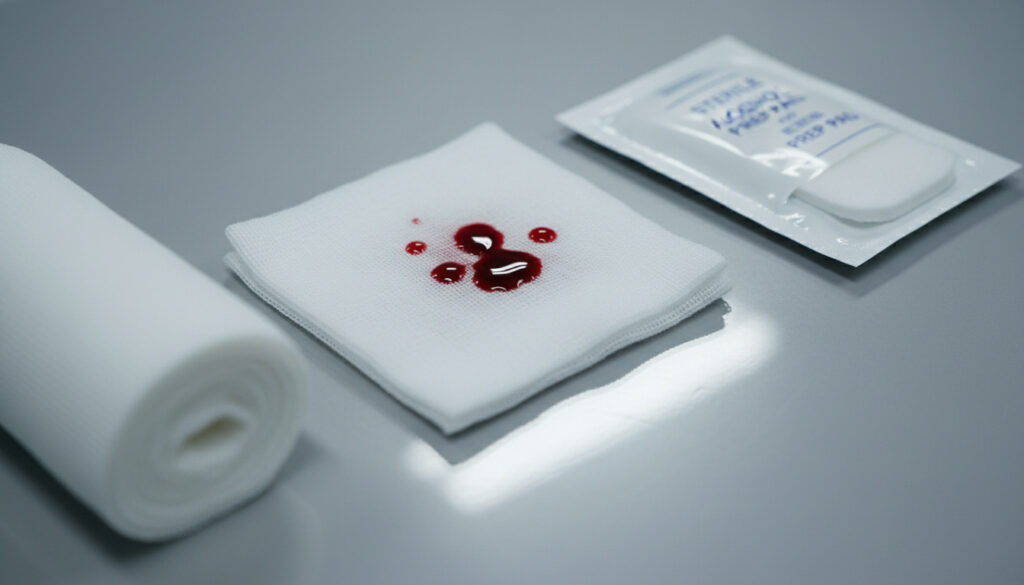
Cover wound with clean cloth or gauze. Press firmly with palm for 10-20 minutes without lifting to check.
Raise injured limb above heart level to reduce blood flow, provided no fracture is suspected.
If blood soaks through, add fresh material on top. Never remove original dressing as this disrupts forming clots.
Wrap tightly with bandage once controlled. Watch for shock signs: pale skin, rapid pulse, or confusion.
Critical Insights:
- Direct pressure alone controls bleeding in approximately 90% of minor injuries without additional intervention.
- Clot formation typically requires 10 to 20 minutes of uninterrupted compression; peeking restarts the timer.
- Elevation works synergistically with pressure to reduce hydrostatic pressure in distal vessels.
- Household items—T-shirts, towels, socks—prove equally effective as sterile gauze in emergency scenarios.
- Arterial bleeding, characterized by bright red spurting, demands immediate emergency services regardless of pressure application.
- Shock can develop within 5 to 15 minutes of significant blood loss, preceding visible symptoms.
- Internal bleeding presents without external blood but requires identical urgency through different positioning.
| Bleeding Type | Visual Signs | Immediate Action | Control Timeline |
|---|---|---|---|
| Capillary (Minor cut) | Oozing, dark red | Direct pressure 5-10 min | 5-10 minutes |
| Venous (Deep cut) | Steady flow, dark red | Pressure + elevation | 10-20 minutes |
| Arterial (Severe) | Spurting, bright red | Pressure + call 911 | Requires medical care |
| Nosebleed (Anterior) | Flow from nostrils | Pinch soft tissue, lean forward | 10-15 minutes |
| Internal | Pain, bruising, rigid abdomen | Lie flat, elevate legs | Immediate emergency |
| Amputation | Complete severance | Pressure + preserve limb | Immediate emergency |
What Is the Fastest Way to Stop a Cut from Bleeding?
Speed matters when managing lacerations. The fastest approach varies by wound depth and location, but the universal constant remains uninterrupted pressure.
Minor Cuts and Scrapes
Superficial injuries affecting only the epidermis rarely require professional care. After washing hands, apply direct pressure with a clean paper towel or cloth for five to ten minutes. Once bleeding ceases, rinse the wound gently with clean water and cover with an adhesive bandage. Mayo Clinic Health System guidelines emphasize that infection prevention becomes the priority only after bleeding stops. For those interested in precise measurements in other contexts, see 5 Feet 4 Inches in CM Conversion.
Deep Lacerations
Cuts penetrating into subcutaneous tissue or exposing fat require sustained pressure for twenty minutes minimum. Mayo Clinic protocols specify that deeper wounds necessitate longer compression times due to increased vascular exposure. If blood saturates the initial dressing, reinforce with additional layers rather than replacing the original cloth, which maintains the developing clot structure.
In emergencies, sterile gauze proves unnecessary. Clean T-shirts, towels, socks, or sanitary pads provide effective compression. Shoelaces, neckties, or sheet strips serve as securing bandages. Stopping hemorrhage takes precedence over sterility; infection risks are addressed post-stabilization.
What to Do If Bleeding Doesn’t Stop?
Persistent bleeding despite proper technique indicates either an arterial injury, coagulation disorder, or inadequate pressure application. Recognizing these scenarios triggers emergency protocols.
Recognizing Critical Hemorrhage
Blood that spurts rhythmically or fails to slow after twenty minutes of firm pressure suggests arterial involvement or significant vessel damage. Harvard Health advises that such cases require immediate emergency medical services regardless of apparent severity. Additional warning signs include blood soaking through multiple layers of dressing, exposed bone, or embedded objects.
Advanced Control Techniques
When direct pressure fails on limbs, wound packing with cloth strips combined with arterial pressure point compression may temporarily reduce flow. Pressure points lie between the wound and heart, pressed firmly against underlying bone for no more than five minutes. Mass General Brigham identifies the brachial artery (inner upper arm) and femoral artery (groin) as primary control sites. Commercial tourniquets serve as absolute last resorts for limb hemorrhage only, applied two to three inches above the wound without covering joints.
Monitor for pale or clammy skin, rapid shallow breathing, weak pulse, confusion, or declining responsiveness. Position the victim on their back with legs elevated approximately twelve inches to maintain blood flow to vital organs. Cover with blankets to prevent heat loss.
Should You Use Ice or Other Methods to Stop Bleeding?
Popular misconceptions surround bleeding control, particularly regarding home remedies and temperature applications. Evidence-based protocols exclude several widely circulated techniques.
Elevation vs. Cold Application
Raising the wounded limb above heart level demonstrably reduces blood flow through gravity assistance, provided no fracture exists. Conversely, WebMD guidelines do not recommend ice application for acute bleeding control. Cold therapy serves subsequent swelling reduction only after hemostasis achieves stability.
Evaluating Alternative Remedies
Cayenne pepper, coffee grounds, and similar household substances lack support in medical literature for promoting clotting. These materials introduce particulate matter into wounds, increasing infection risk without accelerating hemostasis. Better Health Victoria confirms that only mechanical compression and elevation receive endorsement for initial field treatment.
Never remove saturated dressings to check progress—this dislodges fragile clots. Avoid pressing directly on embedded objects, eye injuries, or suspected skull fractures. Do not give food or drink to bleeding victims, particularly those with abdominal injuries.
How Long Should You Apply Pressure to Stop Bleeding?
Timeframes for pressure application vary by injury severity, but minimum durations apply universally. Premature release interrupts the platelet aggregation essential for clot formation.
- : Initiate firm pressure immediately upon exposure. Position yourself to maintain force without fatigue.
- : Maintain continuous compression without checking progress. For minor cuts, bleeding often slows significantly within this window.
- : Deep wounds require sustained pressure throughout this period. Add absorbent layers if blood seeps through, but never remove original material.
- : If bleeding persists despite proper technique, activate emergency services immediately. Texas Department of Insurance guidelines designate this threshold for professional intervention.
What Stops Bleeding Immediately?
Distinguishing between proven interventions and unverified claims prevents dangerous delays in care.
| Established Methods | Unproven or Discouraged |
|---|---|
| Direct firm pressure on wound site | Cayenne pepper application |
| Elevation above heart level | Ice directly on wound |
| Continuous compression 10-20 min | Coffee grounds or flour |
| Wound packing for large cavities | Removing soaked dressings |
| Pressure points (temporary) | Licking the wound |
| Commercial tourniquets (limbs only) | Elevating head for shock |
Why Does Pressure Stop Bleeding?
Mechanical compression achieves hemostasis through physiological principles. When external force exceeds arterial and venous pressure within the vessel, blood flow slows sufficiently for platelets to aggregate at the injury site. This aggregation initiates the coagulation cascade, transforming liquid blood into a gel-like clot that seals the vessel wall.
Elevation supplements this process by reducing hydrostatic pressure in distal extremities. By positioning the wound above the heart, gravity assists venous return while decreasing the arterial pressure gradient. Combined with direct compression, this dual approach addresses both the mechanical and circulatory components of active bleeding.
Understanding these mechanisms explains why intermittent pressure fails—clot formation requires sustained platelet contact with subendothelial collagen. Each interruption disperses the nascent clot, restarting the ten-to-twenty-minute formation window.
What Do Medical Authorities Recommend?
Leading medical institutions maintain consistent messaging on hemorrhage control, emphasizing simplicity and speed over complex interventions.
“Apply pressure directly to the wound using a sterile dressing or clean cloth. Maintain pressure for at least 20 minutes. Do not remove the dressing to check the wound; adding additional layers if necessary.”
— Mayo Clinic Emergency Guidelines
“For severe bleeding, call 911 immediately. While waiting for help, press hard directly on the wound with your hands or any available clean material. Elevate the injury above the heart if possible.”
Key Takeaways on Controlling Bleeding
Effective bleeding control requires immediate, sustained direct pressure for ten to twenty minutes, supplemented by elevation when anatomically safe. Arterial bleeding, spurting blood, or persistent flow despite proper technique necessitates emergency services. Dispelling myths about ice, cayenne pepper, or other home remedies prevents dangerous delays. While medical dramas like Cast of Resident Alien occasionally depict first aid scenarios, real-world hemorrhage control depends on these fundamental pressure techniques rather than dramatic interventions.
Frequently Asked Questions
Does putting pressure on a wound stop bleeding?
Yes. Direct pressure compresses blood vessels against underlying tissue, allowing natural clot formation. This method stops approximately 90% of minor bleeding within 10-20 minutes.
How do you stop bleeding without a bandage?
Use any clean cloth, T-shirt, towel, or sock as a compress. Maintain firm palm pressure directly on the wound. Household items prove equally effective as sterile medical supplies for initial control.
Is it safe to use ice to stop bleeding?
No. Medical guidelines do not recommend ice for active bleeding control. Ice addresses swelling reduction only after bleeding stops. Pressure and elevation remain the primary interventions.
Does cayenne pepper stop bleeding?
No evidence supports cayenne pepper for wound care. It may irritate tissue and introduce infection without promoting clotting. Use direct pressure instead.
Should you elevate a bleeding wound?
Yes, elevate above heart level unless a fracture is suspected. Elevation reduces blood flow to the area, working synergistically with direct pressure to control hemorrhage.
What household items stop bleeding fast?
Clean T-shirts, towels, socks, sanitary pads, or sheets work effectively. Shoelaces or ties secure dressings. Sterility is secondary to stopping blood flow in emergencies.
More related posts
 Goldilocks and the Three Bears: Story, Moral & Lessons
 New Movies Coming Out – November 2024 Theater Guide
 I’m Glad My Mom Died – Full Summary and Key Facts
 Family Doctors Near Me Accepting New Patients – Guide & Tips
 Mmol/L to Mg/DL – Conversion Chart, Formula and Guide
 1/4 Cup to Tbsp – Quick Conversion Guide for Cooks
 Best Outdoor Activities Nearby in Ireland: Top Guide
 Copa Mundial de Clubes FIFA – 2025 Schedule, Teams, Results Guide